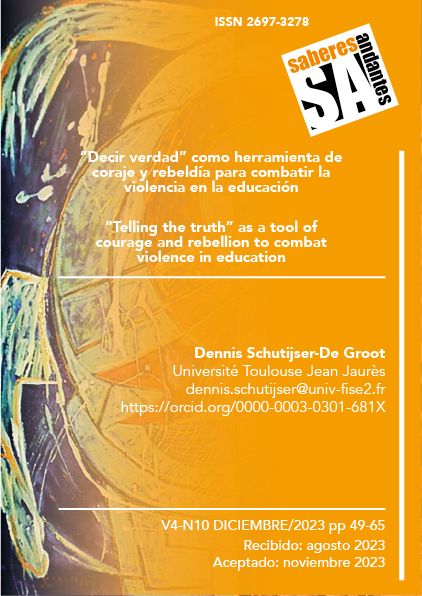
Truth-speaking as a tool to reinsert violence into education
Keywords:
Freire, Foucault, violencia, verdad, parresia, diálogo, corajeAbstract
Contrary to the common opinion which seeks to condemn violence in education and promote a state of peace, education is not violent enough when it does not allow for an interrogation of the systemic and symbolic dimension of violence. The concept of parresía or truth-speaking, coined by Michel Foucault, constitutes a useful tool to reinsert a necessary element of violence into education. It serves to break with the implicit presuppositions in a philosophy of education that seeks to establish a state of peace by focusing its attention on the relation between words and things on the one hand, and by diverting attention from the lived opposition between committed individuals on the other hand. Parresía links the speaker’s commitment, the appeal to the interlocutor, and the encompassing reality of the relationship between them. It can thus give a new direction to philosophy of education in the Latin American context consisting in creating a space of freedom to speak truths. However, this proposal is not without its difficulties, and it notably contains at least two paradoxes for further study and confrontation. The first is that the educator is required at the same time to mobilize their students to commit to speaking their truths, and to be an object of critique in those truths. The second is that speaking truthfully is at the same time a constant exercise in critique of the other, and a creative work of oneself, albeit without a fixed objective.
Downloads
References
Austin, J.L. (1990). Como hacer cosas con palabras. Barcelona: Paidós.
Dewey, J. (2007). Cómo pensamos. Barcelona: Paidós.
Flakin, N. (28 de septiembre de 2020). Their violence and ours. Hampton
Institute. https://www.hamptonthink.org/read/their-violence-andours
Foucault, M. (2010). El coraje de la verdad: el gobierno de sí y de los
otros II. México: Fondo de Cultura Económica.
Foucault, M. (2004). Discurso y verdad en la antigua Grecia. Barcelona:
Paidós.
Foucault, M. (2002). Vigilar y castigar. Buenos Aires: Siglo XXI.
Freire, P. (2012). Pedagogía del oprimido. Madrid: Siglo XXI.
Freire, P. (1976). La educación como práctica de la libertad. Madrid: Siglo
XXI.
González, M. (2015). Las escuelas clandestinas en Ecuador. Raíces de
la educación indígena intercultural. Revista Colombiana de
Educación No.69, Julio/Diciembre, 75-95.
Ley Orgánica de Educación Intercultural (LOEI) de 2015 Ecuador.
Lipman, M. et.al. (1992). La filosofía en el aula. Madrid: Ediciones de la
Torre.
López, J. (2019). Transversalidad de género o ideología de género:
caso Ecuador. Analysis. Claves de Pensamiento Contemporáneo
Vol.24, 163-171.
Lyotard, J. (1983). Le différend. Paris: Éditions de Minuit.
Organización Panamericana de la Salud (2002). Informe mundial sobre la
violencia y la salud: resumen. Washington: Organización Mundial
de la Salud (OMS).
UNESCO. (2011). La filosofía una escuela de la libertad. París: UNESCO
Paillacho, C. (2019). Las limitaciones para abordar la violencia entre
estudiantes: un acercamiento desde los educadores y educadoras.
Saberes Andantes 2(6), 41-54.
Prairat, E. (2019). Propos sur l’enseignement. Paris: PUF.
Wittgenstein, L. (1999). Investigaciones filosóficas. Barcelona: Altaya.
X, Malcolm. (1963). Mensaje a las bases. Conferencia Norteña de Líderes
de Base Negros. Detroit. https://www.marxists.org/espanol/
malcolm_x/obras/1963/nov/10.htm.
Zizek, S. (2009). Sobre la violencia. Buenos Aires: Paidós.
Downloads
Published
Issue
Section
License
Copyright (c) 2023 Dennis Schutijser

This work is licensed under a Creative Commons Attribution-NonCommercial-ShareAlike 4.0 International License.
1. Derechos de autor y licencia
Las obras publicadas en Saberes Andantes se sujetan a los siguientes términos:
1.1. Las personas autoras conservan los derechos de autor y los derechos patrimoniales sobre sus obras, y conceden a Saberes Andantes el derecho de primera publicación.
1.2. Los contenidos se publican bajo la licencia Creative Commons Atribución-NoComercial-CompartirIgual 4.0 Internacional (CC BY-NC-SA 4.0). Esta licencia permite copiar, compartir, distribuir y adaptar las obras, siempre que:
a. Se reconozca adecuadamente la autoría y se cite la fuente original de publicación, incluyendo el nombre de la revista y el enlace permanente o URL del artículo.
b. Se incluya un enlace a la licencia y se indique si se realizaron modificaciones a la obra.
c. El material no se utilice con fines comerciales.
d. Las adaptaciones o trabajos derivados se distribuyan bajo la misma licencia.
1.3. Las personas autoras pueden establecer acuerdos adicionales de distribución no exclusiva de la versión publicada, como su incorporación en repositorios institucionales, páginas personales o plataformas académicas, siempre que se reconozca que la publicación inicial se realizó en Saberes Andantes.
1.4. Los derechos morales de autoría permanecen en todo momento con las personas autoras.